
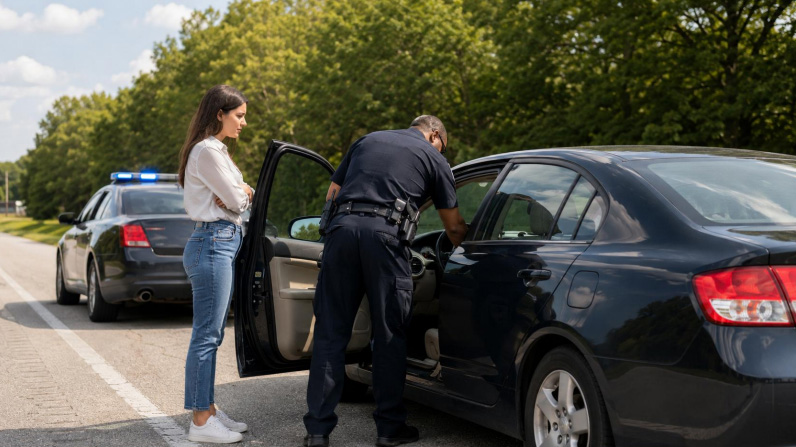
A routine traffic stop can change quickly. An officer may pull you over for speeding or a broken light, ask a few questions, and then ask, “Do you mind if I search your car?”
So, can police search your car after a traffic stop in South Carolina?
Being pulled over does not automatically give police the right to search your vehicle. However, a search may be lawful if you consent or if officers develop another lawful basis to search the car.
The timing also matters. Police generally cannot detain you beyond the purpose of the traffic stop without additional legal justification.
Article I, Section 10 of the South Carolina Constitution protects people against unreasonable searches and seizures, as well as unreasonable invasions of privacy. It also requires search warrants to be supported by probable cause.
Does a Traffic Stop Give Police Permission to Search Your Car?
No. The legal justification for stopping your vehicle is not necessarily a legal justification for searching it.
During a lawful traffic stop, an officer may take reasonable steps related to the traffic violation. That may include checking your driver’s license, registration, insurance information, and outstanding warrants.
But police need an additional legal basis to search the vehicle.
Kent Collins Law Firm has a more detailed discussion of these rules in “How Do Vehicle Searches Work in SC?“ That article covers several types of vehicle searches, while this article focuses specifically on searches that develop during a traffic stop.
When Can Police Search Your Car After a Traffic Stop in South Carolina?
Several circumstances may justify a search following a traffic stop.
You Consent to the Vehicle Search
Police can ask for permission to search your car.
If you voluntarily consent, officers may generally search within the scope of the permission you gave them. You are not required to agree simply because an officer asks.
This distinction is important. A request for consent does not necessarily mean the officer already has probable cause to search.
Questions about whether consent was actually voluntary can also become an issue in a criminal case. The South Carolina Supreme Court considered both consent and the unlawful extension of a traffic stop in State v. Frasier.
The court ultimately reversed the conviction after concluding that law enforcement lacked reasonable suspicion to prolong the traffic encounter and that the defendant had not consented to the search of his person.
Police Develop Probable Cause to Search the Car
Another major exception is commonly called the automobile exception.
Police may be able to conduct a probable-cause car search in SC without first obtaining a warrant if the circumstances provide probable cause to believe the vehicle contains evidence of criminal activity.
What creates probable cause depends on the facts of the stop.
For a more detailed discussion of searches involving suspected controlled substances, see Kent Collins Law Firm’s article on when police can search a car for drugs in South Carolina.
Vehicle searches frequently lead to allegations of possession, distribution, or trafficking. Kent Collins Law Firm also provides information about defending drug charges in South Carolina.
Can Police Extend a Traffic Stop to Investigate Another Crime?
This is one of the most important issues that distinguishes a traffic-stop vehicle search in SC from a general vehicle-search question.
Once officers have completed the tasks related to the reason for the traffic stop, they generally cannot prolong the detention solely to obtain more time to investigate an unrelated crime.
To continue detaining someone, police generally need reasonable suspicion that additional criminal activity may be occurring.
South Carolina’s State v. Frasier Decision
State v. Frasier illustrates why the timeline matters.
Police stopped a vehicle for an inoperable brake light. The investigation then shifted toward suspected drug activity. The South Carolina Supreme Court concluded that the facts relied on by officers did not establish reasonable suspicion sufficient to prolong the traffic encounter.
The court explained that there must be an objective basis for believing criminal activity may be occurring before officers prolong the stop.
For someone challenging a police search car after traffic stop South Carolina case, details such as these may matter:
- Why did police originally stop the vehicle?
- How long did the traffic investigation take?
- Had the officer already issued a ticket or warning?
- What happened before police began asking about unrelated criminal activity?
- Did police ask for consent to search?
- What facts did police claim created reasonable suspicion?
- Did another officer or police dog arrive?
- How much additional time did the investigation add to the stop?
A South Carolina criminal defense attorney can review these circumstances when determining whether a search or continued detention may be challenged. Kent Collins Law Firm handles criminal matters including drug offenses, DUI, property offenses, and other South Carolina criminal charges.
Can Police Make You Wait for a Drug Dog?
A drug dog traffic stop in South Carolina raises a related timing question.
The use of a police dog does not automatically make a traffic stop unlawful. The issue may instead be whether officers extended the stop beyond the time reasonably required to handle the original traffic matter.
If police have separate reasonable suspicion of criminal activity, they may have grounds for additional detention. Without that justification, unnecessarily extending a completed traffic stop to continue a drug investigation may be challenged.
This is another reason the exact timeline of the stop matters.
Can Police Search Your Car Without a Warrant in South Carolina?
Yes, sometimes.
Although this article focuses on searches after traffic stops, police do not always need a warrant to search a vehicle. Consent, probable cause, and other recognized exceptions to the warrant requirement may allow a search.
That does not mean officers have unlimited authority to search any car they stop.
Whether a warrantless search was lawful depends on the reason for the search and what happened before it.
What Should You Do if Police Ask to Search Your Car?
If an officer asks for permission and you do not want to consent to a search, you can clearly state that you do not consent.
If officers search anyway, do not physically interfere. Whether police had the legal authority to conduct the search can be addressed later through the criminal court process.
Try to remember the sequence of events. Timing, statements made by officers, whether you consented, and the stated reason for the search may later become important.
FAQ About Car Searches After South Carolina Traffic Stops
Can I refuse to let police search my car in South Carolina?
You can refuse a request for voluntary consent. However, police may still search if they have another lawful basis, such as probable cause.
Does refusing consent give police probable cause?
Refusing to voluntarily consent is not the same as giving officers probable cause. Probable cause depends on the circumstances known to police.
Can police search my trunk after a traffic stop?
Potentially. If police have legal grounds to search the vehicle, the permissible scope of the search can depend on what officers are lawfully searching for and where that evidence could reasonably be located.
Can police extend a traffic stop in South Carolina?
Police may be able to extend a traffic stop when additional reasonable suspicion of criminal activity develops. They generally cannot prolong a completed traffic investigation simply to look for unrelated evidence without adequate legal justification.
What if police find drugs during the search?
If the search results in drug charges, the legality of the original stop, any extended detention, consent, probable cause, and the search itself may all need to be reviewed.
Talk With Kent Collins Law Firm About a Traffic Stop Search
If a traffic stop in South Carolina led to a vehicle search and criminal charges, the circumstances leading up to that search may matter to your defense.
Kent Collins previously worked as a prosecutor in Orangeburg and Lexington counties before entering private practice. Kent Collins Law Firm represents clients facing criminal charges in Lexington and throughout South Carolina.
To discuss the circumstances of your traffic stop, arrest, or vehicle search, contact Kent Collins Law Firm here or call 803-808-0905.

Schedule Your Free
In Person Consultation!
Contact Kent Collins